Geotechnical Engineering in Wollongong

Together, we solve the challenges of tomorrow.

LEARN MORE →

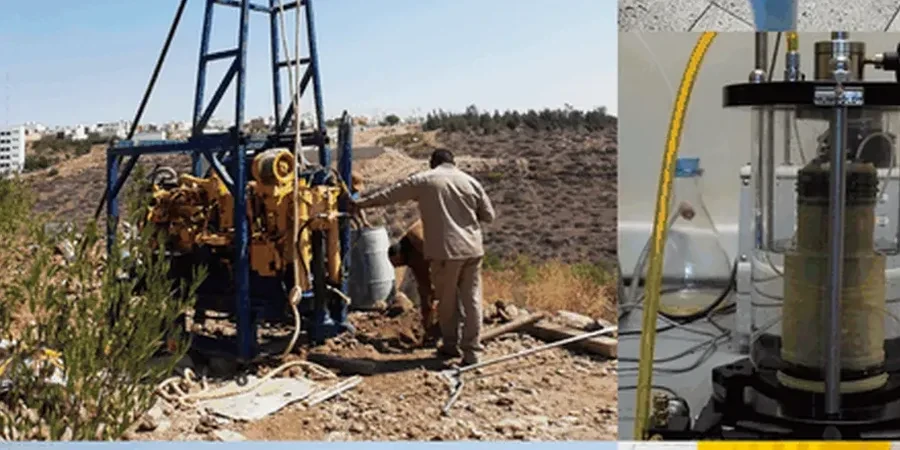
The Illawarra escarpment meets the sea at Wollongong and this collision of geology creates a ground profile that shifts dramatically within a few hundred metres. Colluvium from the steep slopes overlies residual siltstone and sandstone: the material is often unsaturated, with clast-supported fabric that drains fast but compresses erratically under load. A soil mechanics study here has to separate the influence of relic jointing from the mass behaviour of the matrix. Our laboratory processes that physical evidence: we consolidate specimens in incremental load steps, measure pore pressure response in triaxial cells, and derive the strength envelope that governs bearing capacity. Tunnelling and deep excavation projects near Crown Street or along the Princes Motorway corridor frequently encounter these transitional materials and the engineering assumptions need calibration against measured index properties. For large-scale earthworks we combine the soil mechanics program with in-situ permeability testing to capture the drainage boundary conditions that control consolidation time.

A Wollongong residual profile can lose up to 40% of its undrained shear strength when slickensided fabric is ignored in triaxial interpretation.
Geotechnical Engineering in Wollongong
Technical reference image — Wollongong

How we work

Soil conditions in Wollongong change between the narrow coastal plain and the foothills. Near North Wollongong Beach, dense quartz sand ridges can reach relative densities above 75%, offering high tip resistance but potential for dilation-induced negative pore pressure during shearing. Move inland toward Figtree or Keiraville and the profile shifts to stiff residual clay over weathered Hawkesbury Sandstone: the clay fraction dictates the drained strength, while the sandstone transition zone often behaves as a soft rock with an unconfined compressive strength around 5-12 MPa. We characterise both materials in the same soil mechanics study by running a suite of index and strength tests: particle size distribution, Atterberg limits, direct shear at multiple consolidation pressures, and unconsolidated undrained triaxial for the clay phase. The residual profile in Wollongong typically shows a distinct slickensided fabric at depth that reduces the operative friction angle by 3-5 degrees compared with intact samples. These details matter when designing retaining structures near the escarpment where a slope stability assessment relies on the correct drained parameters.

Site-specific factors

A common mistake on Wollongong sites is treating the upper colluvium as a homogeneous fill-like material and assigning a generic friction angle of 30° without testing. This layer often contains boulders up to 400 mm within a silty sand matrix: the bulk shear strength is controlled by the matrix, not the clasts, and can drop below 28° if the fines content exceeds 35%. Designers who skip a proper soil mechanics study sometimes specify shallow pad footings with a bearing pressure that mobilises creep in the colluvial matrix, leading to differential settlement within the first 12 months of service. In the northern suburbs like Bulli and Woonona, old coastal lagoon deposits add another complication: organic silts with loss on ignition above 6% that consolidate poorly. Running oedometer and triaxial tests on these materials before finalising foundation depth avoids expensive underpinning later.

Need a geotechnical assessment?

Reply within 24h.

Email: [email protected]

Reference parameters

ParameterTypical value
Triaxial test typeCIU, CD, UU per AS 1289.6.4.1/6.4.2
Effective friction angle (residual clay)22°–31° depending on plasticity
Undrained shear strength (stiff residual clay)60–150 kPa
Consolidation coefficient cvReported from oedometer per AS 1289.6.6.1
Sample preparationUndisturbed Shelby tube or block samples
Reporting standardAS 1726-2017 geotechnical site investigation log format
Lab accreditationNATA ISO/IEC 17025 for mechanical testing suite

Associated technical services

01

Strength and compressibility testing

We run triaxial compression (CIU and CD configurations) and direct shear on intact specimens recovered from boreholes across the Wollongong LGA. Oedometer consolidation tests produce mv and cv values for settlement prediction. All stages follow AS 1289 methods and are reported with stress-strain curves, pore pressure evolution, and Mohr-Coulomb envelopes.

02

Index and classification program

Atterberg limits, particle size distribution by sieving and hydrometer, and soil suction measurements provide the classification framework for the mechanical tests. Linear shrinkage and Emerson class tests are added for reactive clay identification, relevant to sites around Dapto and Albion Park where residual basaltic soils can show moderate to high plasticity.

Applicable standards

AS 1726-2017: Geotechnical site investigations, AS 1289: Methods of testing soils for engineering purposes (full suite), AS 4678-2002: Earth-retaining structures, AS/NZS 1170.0:2002 Structural design actions

Quick answers

What is the typical turnaround for a full soil mechanics study in Wollongong?

For a program covering index tests, triaxial and oedometer consolidation, standard turnaround is 15-20 business days from sample receipt. Urgent single-parameter reports can be delivered in 7 business days. The timeline depends on consolidation stages: incremental loading oedometer tests run 5-7 days for the loading sequence alone.

How much does a soil mechanics study cost for a residential site in Wollongong?

A targeted program for a single-dwelling site in the Wollongong area typically ranges from AU$5.090 to AU$8.740, depending on the number of triaxial tests, oedometer stages, and whether undisturbed sampling from boreholes is included. The final scope is scoped after reviewing the preliminary site investigation data.

Do you test colluvial soils differently from residual soils?

Yes. Colluvium requires careful specimen preparation because large clasts must be excluded or the matrix tested separately. We often run remoulded direct shear at in-situ density for the matrix fraction and report the particle size distribution to quantify the clast proportion. For residual soils, undisturbed sampling is critical and we focus on preserving the in-situ fabric for triaxial testing.
Location and service area

We serve projects in Wollongong and surrounding areas.

View larger map