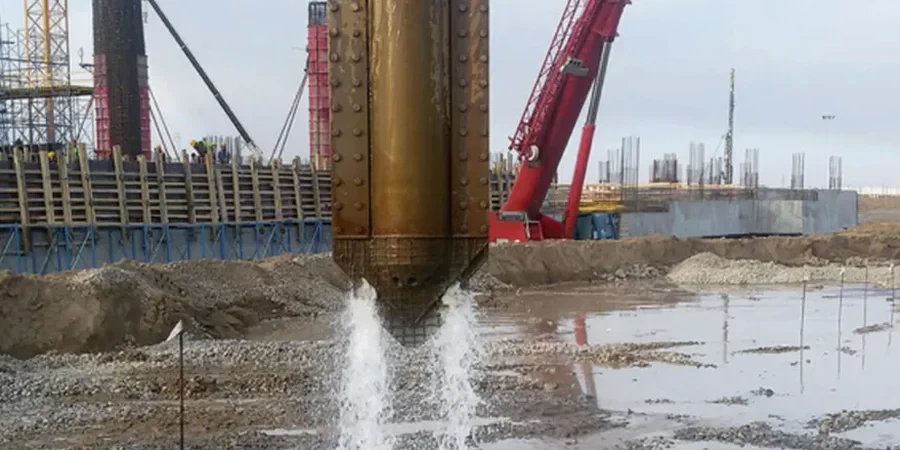
With over 215,000 people living on a narrow coastal plain squeezed between the Illawarra Escarpment and the Tasman Sea, Wollongong has always had to build on whatever ground was available. Much of that ground, particularly across the Port Kembla and Warrawong lowlands, is loose Holocene sand and hydraulic fill placed during mid-century industrial expansion. In our experience, these deposits rarely meet the bearing capacity or settlement criteria for modern structures without intervention. Vibrocompaction design becomes the logical starting point when site investigation reveals SPT N-values below 10 in the upper 4 to 6 metres. We routinely combine the design process with a CPT testing campaign to map clean sand layers precisely, because knowing where the fines content jumps—something common in the interbedded estuarine soils near Lake Illawarra—makes the difference between a successful grid and a wasted mobilisation.
In Wollongong's loose hydraulic fills, a well-designed vibrocompaction grid can cut post-construction settlement by more than 70 percent, but only if the fines content is mapped accurately before the first probe goes in.
Site-specific factors
The risk profile changes sharply between a site on the Port Kembla sand sheet and one up on the lower escarpment terraces near Figtree. Down on the coastal flat, the main concern is liquefaction-induced settlement under the 1-in-500-year seismic event—loose saturated sands at 3 to 8 metres depth are the classic target for vibrocompaction design, and we have seen untreated sites lose over 150 mm in a design earthquake scenario. Up on the foothills, the ground stiffens quickly with depth, but the presence of old undocumented mine workings from the region's coal mining history introduces a completely different failure mode: sudden crown hole collapse that no amount of shallow compaction can prevent. A desk study of historical mine maps, cross-referenced with a MASW survey to detect subsurface voids, becomes essential before committing to any ground improvement strategy in Wollongong's hillside suburbs.
Quick answers
What does vibrocompaction design cost for a typical Wollongong industrial shed site?
For a standard industrial lot around 1,500 to 3,000 square metres in the Port Kembla or Unanderra area, a complete design package—including site-specific analysis, trial compaction specification, and verification testing protocols—typically runs between AU$2,230 and AU$8,040, depending on the depth of treatment and the number of CPT soundings required to characterise the site variability. Projects with extensive historical fill or suspected mine subsidence will sit at the upper end because of the additional geophysical survey effort.
How do you confirm the vibrocompaction has actually densified the sand to the design target?
We rely on a before-and-after comparison of cone penetration test (CPT) tip resistance and sleeve friction. The acceptance criterion is normally a minimum target cone resistance corresponding to a relative density of 70 to 85 percent, depending on the structure's seismic demand category. We also run zone load tests on the treated pad to confirm the overall modulus of the improved ground matches the settlement analysis assumptions.
Can vibrocompaction be used if the sand contains layers of silt or clay?
It depends on the proportion and continuity of the fines. If silt or clay lenses make up more than about 15 percent of the treatment depth, the vibrator energy dissipates too quickly and the soil does not densify uniformly. In those conditions, we would typically switch the ground improvement strategy to stone columns or consider a rigid inclusion system. A detailed particle size distribution analysis from borehole samples is the first step in making that call.