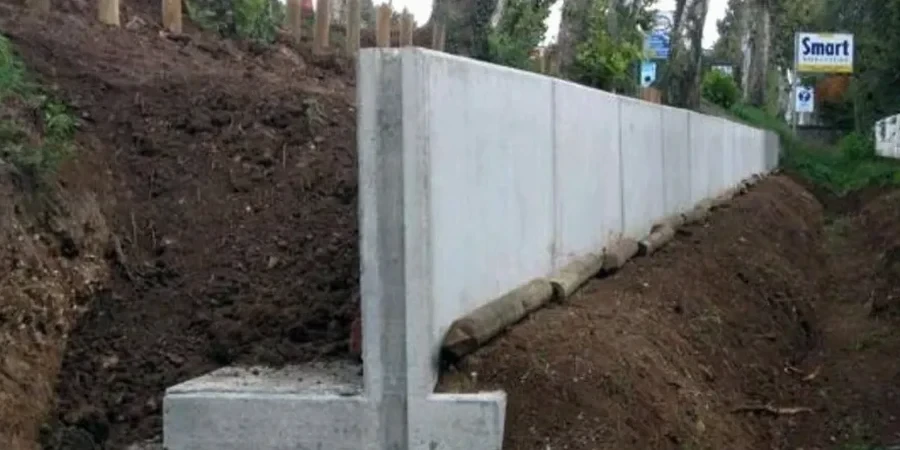
Wollongong’s geology doesn’t do flat. The Illawarra escarpment drops over 400 metres in just a few kilometres, creating residential and commercial sites where a retaining wall isn’t optional — it’s the only way to build. That steep gradient means we’re frequently dealing with colluvium mantles, residual siltstone profiles, and perched water tables that turn a standard gravity wall into a liability if the drainage isn’t thought through. When a client near Mount Keira needed to reclaim 3 metres of backyard from a 35-degree slope, the design had to account for both the loose talus layer at surface and the competent Hawkesbury sandstone at depth. We often pair retaining wall design with a slope stability assessment to capture the full hillside behaviour, and in tighter access we specify test pits to log the colluvium-bedrock interface before finalising the stem geometry. The combination gives the geotechnical engineer a three-dimensional picture that a single borehole can’t provide on these sloping blocks.
A retaining wall on the Illawarra escarpment is a drainage structure first, a structural element second — get the water wrong and the concrete doesn’t stand a chance.
How we work
We’re seeing more Wollongong builds where the wall doubles as the property boundary, which means the design has to work within a 200 mm tolerance and still handle the surcharge from the neighbour’s driveway. A cantilever wall in Woonona on reactive clay will behave completely differently to a block-faced gravity wall in West Wollongong sitting on residual sandstone — same suburb, different suburb geology, and the council’s DA conditions will pick up on it. What makes retaining wall design work here is knowing when to switch from a reinforced concrete stem to a segmental block with geogrid, or when the groundwater warrants a no-fines backfill with a subsoil drain wrapped in geotextile. Every design we produce runs through limit equilibrium checks under AS 4678 for sliding, overturning, and bearing, with global stability verified where the retained height exceeds 1.5 metres. The practical outcome is a wall that doesn’t move, doesn’t hold water, and doesn’t blow out the earthworks budget during excavation.
Site-specific factors
The most expensive retaining wall failure we investigate in Wollongong isn’t a catastrophic collapse — it’s the slow, creeping rotation that cracks the fence line and puts the council on notice. A 2.4-metre gravity wall in Balgownie started tilting 18 months after handover because the builder had backfilled with site-won clay and omitted the strip drain. By the time we were called, the top of the wall had displaced 85 mm outward and the footing had lost bearing on the outer third. Remediation meant demolishing and rebuilding at triple the original cost. The other common failure mode is global instability below the wall toe, particularly on steep colluvium slopes where a cut at the base unloads a pre-existing shear surface. That’s why our retaining wall design scope always includes a subsoil drainage detail, a backfill specification tied to AS 4678 Appendix B, and — for walls over 1.5 metres — a global stability check using Spencer’s method on the as-built slope profile.
Quick answers
What does retaining wall design cost for a typical Wollongong residential site?
For a standard residential retaining wall in the Wollongong LGA — think 1.8 to 3 metres retained height on a sloping block — the design fee typically falls between AU$1,730 and AU$7,210 depending on wall length, ground conditions, and whether anchored or gravity solutions are needed. A straightforward gravity wall with good ground and clear access sits at the lower end; an anchored wall on colluvium with global stability modelling and construction-phase monitoring requirements pushes toward the upper range. The fee covers site investigation interpretation, limit equilibrium analysis, structural detailing, drainage design, and a signed design certificate for council submission.
Do I need a geotechnical investigation before retaining wall design?
Yes, and Wollongong Council will almost certainly ask for it in the DA conditions if your wall exceeds 1 metre in height or is near a boundary. At minimum we need logged boreholes or test pits to determine the founding material — colluvium, residual soil, or bedrock — plus groundwater observations. Without that, the bearing capacity and sliding resistance assumptions are guesswork, and the certifier won’t sign off. For high walls on escarpment blocks we typically recommend CPT testing to get a continuous profile through the colluvium layer, paired with laboratory strength tests on undisturbed samples.
How long does council approval take for a retaining wall design in Wollongong?
It depends on whether the wall triggers a Development Application or can be handled as a Complying Development Certificate. A retaining wall under 1 metre and not associated with a new dwelling usually follows the CDC pathway and can be approved in 2-4 weeks once the design package is lodged. Walls over 1 metre, or on slip-prone land as mapped in the Wollongong LEP, generally require a full DA with geotechnical assessment — budget 8-12 weeks from lodgement to determination. We prepare the design documentation to meet the information requirements upfront so the assessment officer doesn’t issue a stop-the-clock RFI.