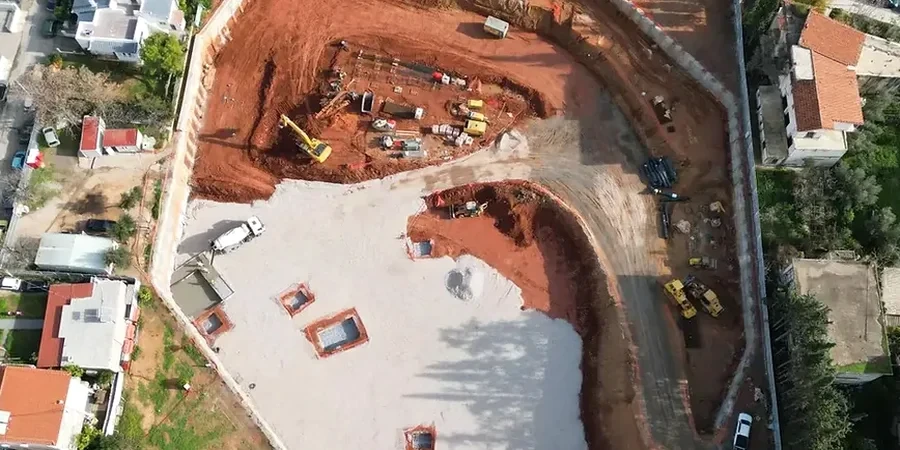
The coastal humidity and steep escarpment terrain of Wollongong create a unique set of challenges for any subsurface project. With average annual rainfall exceeding 1,300 mm and a geology dominated by the Hawkesbury Sandstone overlain by colluvial deposits, water ingress and face instability are constant threats during deep cuts. A solid geotechnical design of deep excavations here must account for the rapid weathering profile of the near-surface rock and the perched water tables that form after heavy rain. Using in-situ data from a CPT test helps refine the stratigraphic model in the soft alluvial pockets near Port Kembla, while a MASW survey can map the bedrock depth across the site before shoring design begins.
In Wollongong, the biggest risk to a deep excavation isn't just the depth—it's the perched water tables within the weathered sandstone that can destabilise a face without warning.
Site-specific factors
The application of AS 4678 in Wollongong is particularly relevant because of the escarpment’s influence on lateral stresses and the potential for soil-structure interaction in deep urban cuts. One of the most common failure modes we see in the region is the uncontrolled relaxation of the jointed sandstone, which can lead to wedge failures if the temporary support is not sequenced correctly. Adjacent to the railway corridor and heritage buildings in the city centre, excessive ground movement is unacceptable. A design that omits a detailed excavation monitoring plan, including inclinometers and piezometers, leaves the contractor blind to the early signs of distress. The risk of flooding from sudden downpours, a regular occurrence along the Illawarra coast, also necessitates a dewatering system sized for a 1-in-50-year storm event, integrated directly into the geotechnical model.
Quick answers
How does the Wollongong escarpment geology affect the cost and complexity of a deep excavation design?
The transition from colluvial soils to Hawkesbury Sandstone means we often need to design for mixed ground conditions. The rock can be highly abrasive and jointed, requiring heavier shoring and more solid dewatering. This typically places the engineering design fee between AU$3,250 and AU$12,190, depending on the excavation depth and the number of retained boundaries.
What groundwater challenges are specific to Wollongong's coastal plain?
The coastal plain contains paleochannels filled with sand and gravel, which act as conduits for groundwater. Combined with the high rainfall, excavations often need a positive cut-off wall or deep well system. Our design includes a transient seepage analysis to size the dewatering capacity accurately and prevent catastrophic base instability.
Can you design a temporary excavation support system that allows for future permanent basement construction?
Yes, we frequently design top-down or semi-top-down sequences where the temporary ground anchors or struts are later incorporated into the permanent slab structure. This approach minimises lateral deflection in Wollongong's built-up areas and speeds up the construction programme by avoiding the need for a separate permanent lining.