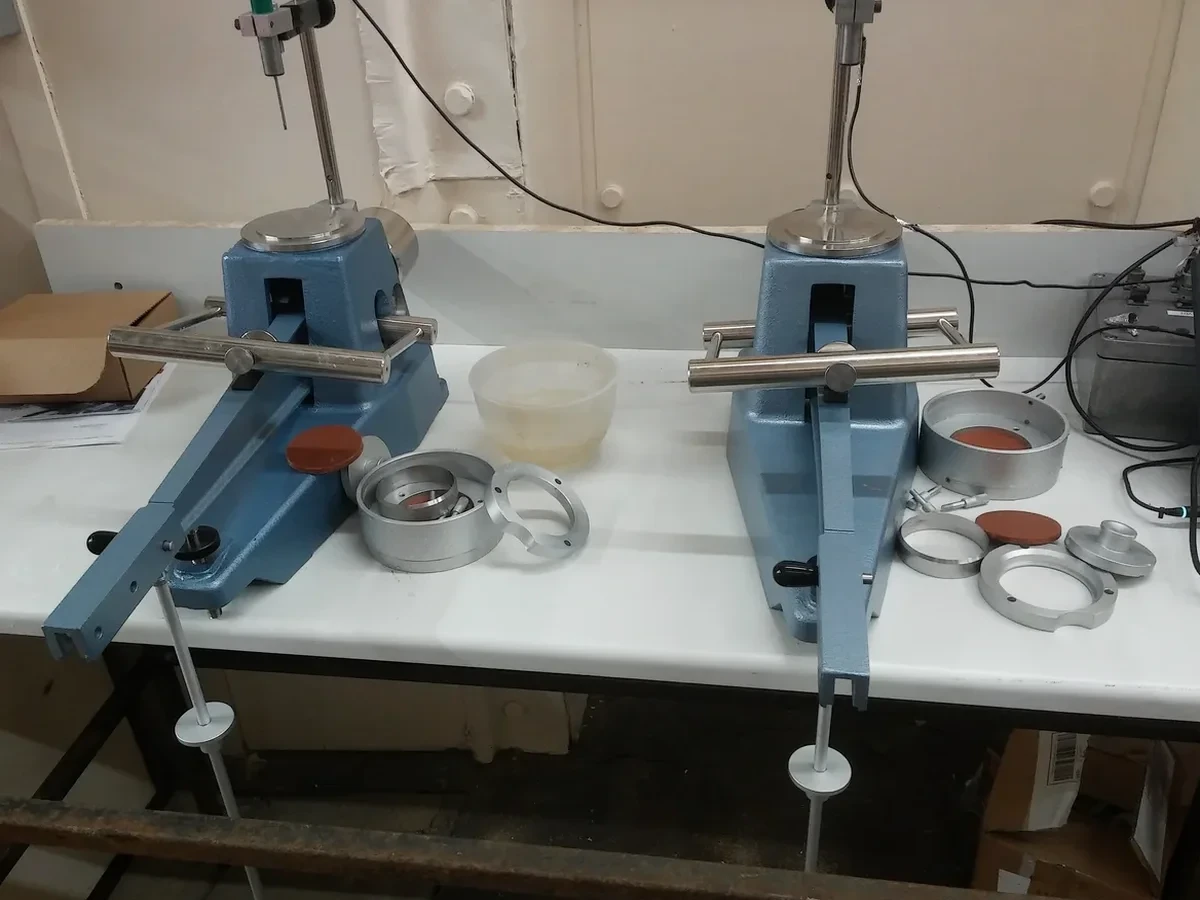
The geotechnical contrast between Wollongong's coastal plain and the escarpment foothills is striking, and it all comes down to the fines. Down near Port Kembla, you're often dealing with saturated alluvial silts that can turn to slurry with the wrong moisture content, while up in the Mangerton or Balgownie slopes, residual clay derived from Permian coal measures exhibits completely different plasticity characteristics. This is precisely where Atterberg limits testing becomes the gateway to understanding how a soil will behave during cut-and-fill operations. Our laboratory routinely runs these classification tests on material from across the Wollongong LGA, from the sandy loams of Dapto to the highly plastic clays encountered in West Wollongong subdivisions. Getting the liquid limit and plastic limit right isn't academic theory — it's what tells you whether that excavated material can be re-used as engineered fill, or if it'll shrink and crack your pavement within two seasons of the coastal rainfall Wollongong gets. We complement this index testing with grain size analysis when the fines content exceeds 35%, giving you the full particle distribution picture needed for AS 4678 compliance in structural backfill.
Atterberg limits transform a handful of moist soil into a predictive tool — telling you in advance whether a clay will heave, shrink, or hold a slope through a Wollongong winter.
Site-specific factors
In Wollongong, we regularly see earthworks specifications that only call for a PI determination, missing the critical step of correlating that number with the actual clay mineralogy present. The Illawarra coal measures produce smectite-rich residual soils that can have a PI of 25% but still exhibit severe volume change due to the expansive lattice structure of the clay minerals. A low PI doesn't always mean low reactivity — and that assumption has caused cracked slabs in Figtree subdivisions and distorted kerbing on arterial roads through Coniston. Without the full Atterberg suite, including linear shrinkage on the minus 425-micron fraction, you're essentially guessing at the soil's behaviour under the repeated wet-dry cycles that Wollongong's subtropical climate imposes. The cost of a reactive site misclassification ripples through the entire project: over-designed footings where they aren't needed, or worse, standard strip footings on a site that demanded stiffened raft construction. When the shrink-swell potential is flagged early through proper index testing, the structural engineer can specify the right footing system from the start, avoiding remedial underpinning costs that can exceed six figures on a single residential lot.
Quick answers
What soil types in Wollongong typically show the highest plasticity index?
The residual clays derived from the Illawarra Coal Measures, particularly the Woonona Claystone and associated volcanic horizons found across the escarpment suburbs, routinely produce PI values above 30%. The Quaternary alluvial clays in the coastal floodplains of the Macquarie Rivulet and Mullet Creek also exhibit elevated plasticity — sometimes exceeding 50% — due to the high organic content and montmorillonite mineralogy deposited in the estuarine environment.
How does AS 1726 define soil classification using Atterberg limits?
AS 1726 classifies fine-grained soils based on their liquid limit and plasticity index plotted on the Casagrande plasticity chart. Soils fall into categories of low plasticity (CL/ML), medium plasticity (CI/MI), high plasticity (CH/MH), or extremely high plasticity (CE/ME). The standard also ties the classification to expected engineering behaviour — including compressibility, permeability, and shear strength — so the Atterberg results feed directly into foundation design assumptions for the Wollongong site.
Do you need a full Atterberg suite for a simple residential footing design in Wollongong?
Yes, even for a standard residential build. AS 2870 (Residential Slabs and Footings) uses the plasticity index and linear shrinkage to determine the site classification — from S (slightly reactive) to E (extremely reactive). In Wollongong, where reactive clays are common even in areas that look like benign pastureland, skipping the Atterberg testing and assuming a non-reactive classification can lead to slab heave, cracked walls, and expensive remedial work within the first five years.
What does Atterberg limits testing cost in Wollongong?
For a standard Atterberg suite — liquid limit, plastic limit, and linear shrinkage — you're generally looking at AU$100 to AU$140 per sample, depending on whether it's a standalone test or part of a larger investigation package. Turnaround is typically three working days, though we can expedite to same-day results for active earthworks where the contractor is waiting on a compaction moisture window.