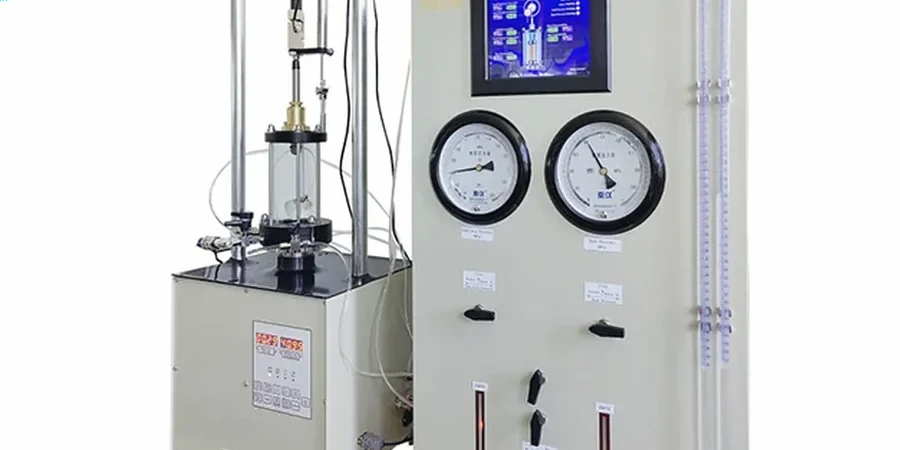
The triaxial cell sits under controlled pressure in our NATA-accredited Wollongong lab, a device that applies axial load while a latex membrane isolates the soil sample. We run these tests on silts, clays, and sands extracted from sites across the Illawarra escarpment, where the geology shifts dramatically within a few hundred metres. A single borehole log tells you what's there, but the triaxial test reveals how the material behaves under the confinement stress your foundation will actually impose. For projects near the Port Kembla industrial area or the CBD fringe, we pair this with a CPT test to correlate continuous profiling data with the laboratory-derived friction angle, giving you a defensible ground model without guesswork.
Effective cohesion and friction angle from a CU triaxial test often reduce required piling depth compared to conservative SPT correlations.
How we work
Soil conditions between North Wollongong and the western suburbs of Figtree can differ entirely: coastal sands near Stuart Park drain freely, while residual clay derived from latite in the foothills holds pore pressure during loading. The triaxial test captures this contrast. We run Consolidated Undrained (CU) stages with pore pressure measurement to isolate effective stress parameters, or Unconsolidated Undrained (UU) tests when the client needs a quick, conservative undrained shear strength for short-term stability checks. Each specimen is trimmed to AS 1726 precision, saturated using back pressure, and sheared at a strain rate slow enough to allow pore pressure equalisation. The result is a Mohr-Coulomb envelope that directly feeds into your bearing capacity calculations or slope stability models, with no need to rely on published correlations that break down in Wollongong's transitional soils.
Site-specific factors
Wollongong's post-war expansion pushed housing into slopes once considered too steep, where cut-and-fill earthworks placed compacted fill over natural colluvium. Many older retaining structures in suburbs like Balgownie and Keiraville were designed without quantified effective stress parameters, relying instead on assumed drained friction angles from generic classification charts. When heavy rain saturates these fills, pore pressure spikes reduce the available shear strength, and walls start to tilt. A triaxial test on undisturbed Shelby tube samples—or reconstituted specimens from bulk fill—gives the real drained friction angle and cohesion intercept needed to back-analyse a failing wall or to design a replacement that meets AS 4678 requirements. Skipping this step means designing for a soil that doesn't exist, and Wollongong's rainfall data from the Bureau of Meteorology station at Bellambi shows why drainage assumptions alone won't save a poorly characterised fill.
Quick answers
How much does a triaxial test cost in Wollongong?
A standard set of three UU triaxial specimens typically runs between AU$3,020 and AU$4,300, depending on specimen preparation complexity and whether undisturbed tube samples or remoulded material is involved. CU testing with pore pressure measurement sits at the upper end of that range due to longer test duration and additional saturation steps.
What's the difference between UU and CU triaxial tests?
UU tests provide total stress undrained shear strength (Su) without pore pressure measurement, useful for short-term loading on saturated clay. CU tests measure pore pressure during shear, allowing separation of effective cohesion (c') and friction angle (φ'), which govern long-term stability and drained conditions.
How long does a triaxial test take from sample to report?
UU triaxial testing on three specimens can be completed within 5 working days. CU testing with pore pressure measurement requires slower shearing and typically adds 3 to 5 extra days. Saturated fine-grained soils take the longest due to low permeability.
What sample quality do you need for accurate triaxial results?
Undisturbed Shelby tube samples in 63 mm thin-walled tubes are ideal for cohesive soils. For granular materials, we use reconstituted specimens compacted to field density. Sample disturbance from poor handling or tube extraction visibly affects the stress-strain curve, so we assess specimen quality before testing.
Can you test Wollongong's residual clay soils in the triaxial cell?
Yes, we regularly test the latite-derived residual clays common across the Illawarra escarpment. These materials can contain relict joints, so we trim specimens carefully and often run CU tests to capture the effective stress behaviour that governs slope stability in suburbs like Mount Keira.