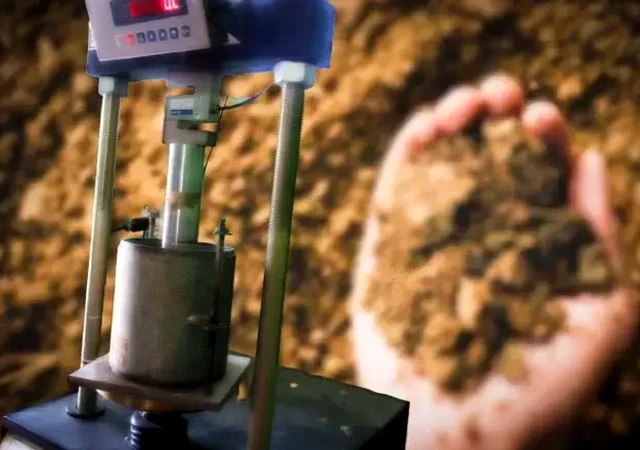
The CBR press sits in the corner of our lab, a steady hydraulic ram loading a 50 mm plunger at 1 mm per minute into a compacted soil specimen. It's unglamorous. But for Wollongong's road builders, that load-penetration curve dictates pavement thickness and aggregate depth. You need a figure that stands up to B-Double traffic on the M1 Princes Motorway and the aggressive wet-dry cycles rolling off the Illawarra Escarpment. For subdivision access roads in West Dapto's expanding corridor, a subgrade CBR below 3% means trouble. We run the test to AS 1289.6.1.1, standard compactive effort, four-day soak to simulate saturated conditions. The flexible pavement design relies on this number. No shortcuts. We've seen too many local pavements rut after one wet summer because someone accepted an optimistic soaked CBR. The lab data, plotted on a chart with the standard curve, is the evidence you need for council approval.
Soaked CBR is not a soil property. It's a performance test that tells you how the local material will behave after a week of Wollongong rain.
How we work
AS 1289.6.1.1 is the governing standard here, and it's mandatory for any Transport for NSW-funded project in the Wollongong LGA. The local geology demands it. You're dealing with residual soils from the Hawkesbury Sandstone up on the plateau, colluvium along the slopes, and estuarine silts near Port Kembla. Each material responds differently to a four-day soak. Our lab compacts at standard or modified effort, depending on the spec. We take the sample from your site, remould it at optimum moisture content from a Standard Compaction curve, and submerge it. The plunger penetrates while a load ring or electronic cell records resistance at 2.5 mm and 5.0 mm. The result, expressed as a percentage, tells the pavement designer exactly what's needed: a thick gravel layer, a stabilised subgrade, or a complete material replacement. For reactive clay zones around Figtree, the soaked CBR often drops dramatically; the swell measurement during the soak is just as critical.
Quick answers
What does a laboratory CBR test cost in Wollongong?
A standard soaked CBR test on a single remoulded sample typically falls between AU$180 and AU$340, depending on whether we run the standard or modified compactive effort. A full pavement investigation package, including soil classification, compaction test, and multiple CBR points, is a separate quote. The price reflects the four-day soak time and the lab preparation required for each specimen. Call for a rate card based on your project's number of samples.
Why is a four-day soaked CBR required, not just an immediate test?
The soaked CBR simulates the worst-case condition: a fully saturated subgrade after prolonged rain. Wollongong's annual rainfall exceeds 1300 mm, and the Illawarra Escarpment funnels groundwater into the coastal plain. An unsoaked CBR gives a false sense of strength. The four-day soak is mandatory per AS 1289.6.1.1 for any pavement design under RMS or local council specifications. Skipping it voids the design.
How many CBR samples do I need for my subdivision?
RMS guidelines typically require one CBR per distinct soil type, with a minimum of three to five points per project, depending on the length of road and variability of the subgrade. For a typical Wollongong residential subdivision with 500 metres of access road, we recommend sampling at each major cut and fill transition and at any areas where the soil type visibly changes. The lab can batch up to 12 specimens in one cycle.
Can you test aggregate basecourse with the CBR method?
Yes, but the procedure and interpretation differ from subgrade testing. For unbound granular basecourse materials, we run a modified compactive effort and process the sample through a 19 mm sieve. The CBR of a quality DGB20 basecourse from a local quarry like Dunmore or Albion Park typically exceeds 80%. The test confirms the material meets RMS specification before it's trucked to site.
What's the difference between lab CBR and a field CBR test?
A lab CBR tests a remoulded specimen compacted to a known density and moisture content under controlled conditions. A field CBR, done with a dynamic cone penetrometer or a plate-bearing rig, tests the soil in its natural state. The lab test is the design input. The field test is the verification tool. Both have their place, but for pavement thickness design, the soaked lab CBR is the mandatory input per AS 1289.