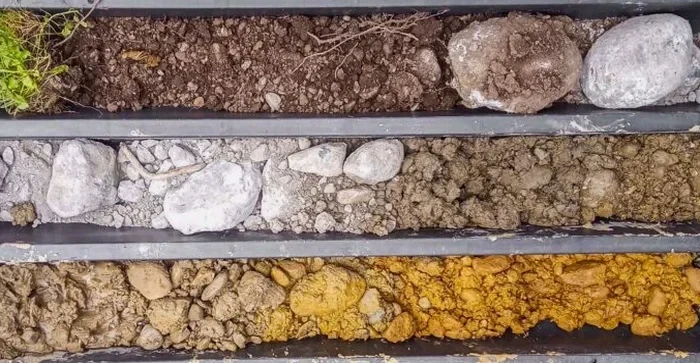
The excavator bucket hits the claystone at two metres. That is the first real data point no borehole log can fully replicate. In Wollongong, where the Illawarra Escarpment dictates drainage paths and residual soils sit directly over Permian bedrock, an exploratory test pit gives the project geologist an open face to log. We use 5-tonne to 14-tonne tracked excavators on sites from Thirroul to Dapto. The trench goes down to 3.5 metres or refusal. The walls are cleaned, photographed, and logged to AS 1726. You see the colluvium, the mottling, the seepage horizon. That visual record matters when you are placing a pad footing near a gully line or assessing reactive clay depth under a slab. It also matters when you need undisturbed block samples for triaxial testing to get drained strength parameters for cut slope design.
An open excavation reveals what a 50 mm core cannot: the true fabric of the ground.
Quick answers
What depth can a test pit reach in Wollongong's ground conditions?
With a 14-tonne excavator we reach approximately 3.5 metres in soil. Refusal on shallow bedrock, common along the escarpment foothills, often limits depth to 1.5 to 2.5 metres. In deep alluvium near the Port Kembla area, 3.5 metres is achievable.
How much does an exploratory test pit cost in the Illawarra?
A single pit with machine mobilisation, excavation, logging, sampling, and backfill typically ranges from AU$780 to AU$1,170. The final figure depends on access constraints, depth reached, and the number of samples required for laboratory testing.
Which Australian standard governs the logging of test pits?
We log, sample, and describe soil and rock in accordance with AS 1726-2017. This standard defines the terminology for consistency, moisture condition, colour, and structure used in every report we issue.
Can you collect undisturbed samples from a test pit?
Yes. Block samples are cut directly from the pit face and sealed on site to preserve natural moisture and structure. Sidewall Shelby tubes can also be pushed into cohesive layers. These samples are suitable for triaxial or consolidation testing at our NATA-accredited laboratory.